productivitypersonal experiencesecond brain
I Used to Lose My Best Ideas. Then I Built a Second Brain
We consume more information than our brain can hold. Here's why building a Second Brain changed the way I work, and how you can start your own.
April 19, 2026
How many great ideas have you had that vanished before you could use them?
For me, it happened all the time. I would read a fantastic article on the train, listen to a podcast while washing the dishes, or get hit by a brilliant idea in the middle of the gym. By the time I actually needed that knowledge, whether for a meeting, a blog post, or a new project, it was already gone.
The truth is, we consume more books, articles, podcasts, and videos every day than any human can absorb or recall. And most of that information hits us at the wrong time: while we are relaxing, working, or just scrolling memes on Instagram.
For years, I kept losing the good stuff and hoped the next productivity app would fix it. None of them did. What I was missing was not a tool. It was a system.
Discovering the Second Brain
Back then, in the hometown where I lived, I used to wander around a local bookstore on weekends. One day I picked up a book called Building a Second Brain by Tiago Forte. The back cover clicked instantly. It named the exact problem I had been living with for years.
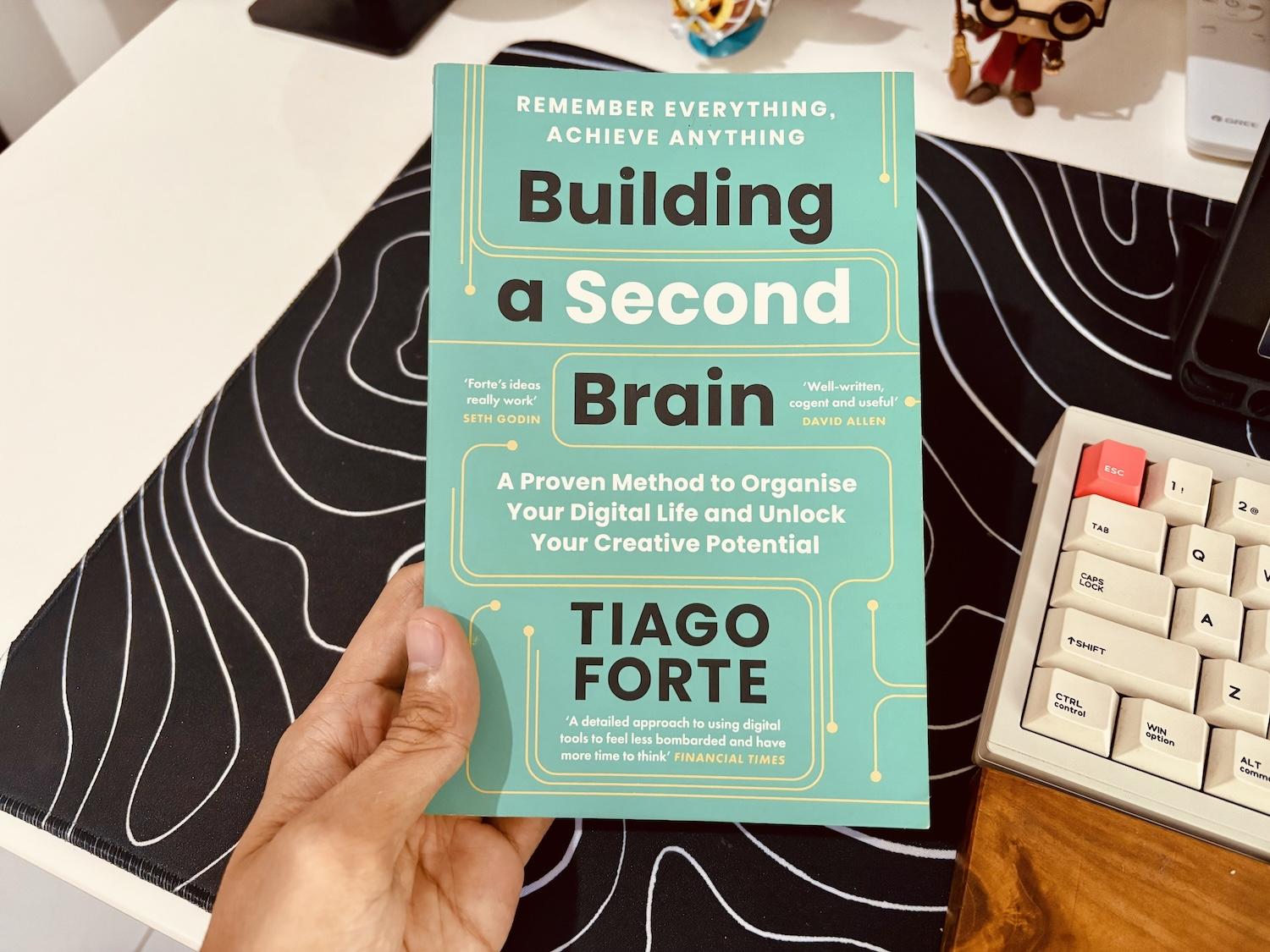
Tiago defines a Second Brain as:
A digital archive of your most valuable memories, ideas, and knowledge to help you do your job, run your business, and manage your life without having to keep every detail in your head.
Some people call it a “personal cloud,” “field notes,” or an “external brain.” The name doesn’t matter. What matters is that it is a trusted place where your best thinking lives, so you can come back to it whenever you need.
How It Changed the Way I Work
Adopting a Second Brain changed my relationship with information in three important ways.
1. Nothing Valuable Slips Through
Before, interesting ideas would disappear the moment something urgent pulled my attention away. Now, every note, highlight, and half-formed idea lands in one trusted place. I don’t have to hold it in my head anymore.
2. I Reuse My Best Thinking
This one is my favorite. Past conclusions are available on demand, so I do not solve the same problem twice.
Last month I opened a note I wrote two years ago about hiring engineers and used it to draft a decision in fifteen minutes. Past-me did the hard thinking. Present-me just shipped. It feels like collaborating with a slightly younger version of myself.
3. It Frees Up Mental Space
When my notes live outside my head, I spend less time searching and more time on the creative work only I can do. I can also turn work “off” and relax, knowing that I have a trusted system keeping track of all the details.
A Second Brain in the Age of AI
When I first adopted this system, ChatGPT did not exist. My notes sat quietly in folders until I went looking for them. That has changed completely.
Now, AI can read across my entire archive and turn it into a personal assistant. One that remembers what I worked on last year, what I am building today, and what ideas I have been chewing on for months. Instead of digging through folders, I just ask:
“What did I write about X?”
And I get a synthesis in seconds.
If you are curious how I set this up in practice, I wrote about it in Why I Moved from Notion to Obsidian where my Vault sits in plain Markdown files that AI agents can read directly.
How to Start Your Own Second Brain
The most common mistake I see is people trying to build the “perfect system” before writing a single note. Don’t do that.
Here is what I would suggest instead:
- Pick one app you will open every day. It can be Obsidian, Notion, Apple Notes, or even a plain text file. The app is not what matters.
- Dump everything worth remembering into it. Links, highlights from books, half-formed ideas, meeting notes, anything that you might want to revisit.
- Don’t sort, don’t tag, don’t optimize. Structure can wait until you actually have something to structure. Premature organization is a form of procrastination.
- Review it occasionally. Every week or two, scroll through recent notes. You will be surprised how often an old idea connects to a new problem.
The only real failure mode is not capturing.
Conclusion
A Second Brain changes your relationship with information. Technology stops being just storage and starts being a partner you think with. One that remembers for you, so you can focus on deciding, creating, and actually living.
You don’t need the perfect app. You don’t need a complex tagging system. You just need to start capturing today, and trust that future-you will thank present-you for it.
If you have already started building your own Second Brain, I would love to hear what app you use and how it has helped you. Drop a comment below.
Thank you for reading 👋
Comments